
The original settlers of the South Pacific came from what we now call China and Southeast Asia, and entered the Western Pacific in two separate groups. The first group traveled into the South Pacific about 40,000 years ago, and the second arrived over 30,000 years later.
Want to see a BIGGER MAP? Click here.


Our earliest ancestors lived in caves and rock-shelters in China and Southeast Asia. They hunted and gathered food to survive. We know this because archaeologists found animal bones and tools in the caves and rock-shelters where they lived.
Want to see a BIGGER MAP? Click here.


About 40,000 years ago, these hunters and gatherers began to move from China and Southeast Asia to Australia, Papua New Guinea and the Islands of Southeast Asia. We can tell by looking at the age of the tools and animal bones found in caves and rock shelters in that region.
Want to see a BIGGER MAP? Click here.


Over 30,000 years after the first group left China and Southeast Asia, a second group traveled further into the Pacific region. This was about 6,000 years ago. Unlike the hunters and gatherers of the first voyages, this second group had domesticated animals and practiced agriculture.
This second group was different in several ways. They dug irrigation ditches for taro planting and drained swamps to help them farm. They also built their own homes rather than lived in caves and rock shelters.
Want to see a BIGGER MAP? Click here.


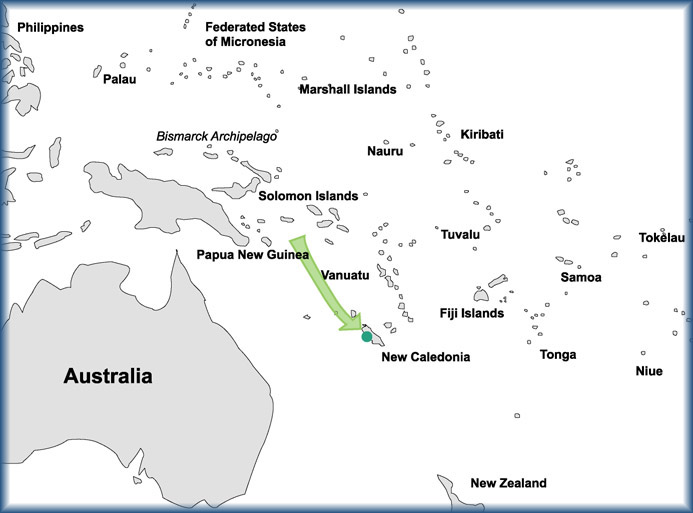

Since pottery survives for such a long time, and since the markings on the Lapita pottery are quite unique, archaeologists have been able to figure out the migration routes of the Lapita people by comparing the dates, designs and soil from pieces of pottery and tools found in different parts of the western tropical Pacific Islands.
By dating the pottery and comparing the markings, we know that some of the 'Lapita' people voyaged from Papua New Guinea and Solomon Islands south east to Vanuatu, New Caledonia, Fiji, Tonga and Samoa which they reached 3,000 years ago.
Want to see a BIGGER MAP? Click here.


In the next millenia, the Lapita culture gradually disappeared, but their descendants continued to travel, crossing large expanses of the ocean and settling in other uninhabited island groups like the Marquesas by 300 AD, Society Islands, Cook Islands and Hawaii by 600 AD and New Zealand around 750 AD.
Want to see a BIGGER MAP? Click here.


Caves are chambers beneath the surface of the earth or in the side of a hill, cliff or mountain while rock-shelters are simple dwellings made of piles of rocks built by our ancestors. Our earliest ancestors either lived in such dwellings or built simple rock-shelters where they could stay for a while to sleep, prepare and cook their food until the local supply of food in the area begins to dwindle. When that happens, they go and journey once more leaving behind traces of how and when they lived on the cave floors. back to page
People who live by hunting and gathering wild food.
Hunters and gatherers hunted all kinds of animals, fished along coasts, lakes and rivers; gathered plants, seeds, fruits, berries, wild vegetables and even shellfish for food. They were forced to move from one place to another whenever the local supply of food starts to finish. They lived in caves and rock-shelters where our archaeologists found remnants of ancient campfires and stone tools these prehistoric people used for hunting, fishing and cutting up their food. back to page
Many remains of plants, seeds, animal and human bones, stone and wooden tools; and personal ornaments like bracelets, rings, necklaces and pendants, were left behind by our ancestors. By studying these remains, archaeologists are able to tell us what kind of life they lived and when they occupied the site where these remains were found. back to page
The tools, animal bones and pottery found in many sites where our ancestors once lived are studied by archaeologists to see whether they could figure out HOW and WHEN these people lived.
The scientific way of collecting and studying the remains left behind our ancestors is called Archaeology. Archaeology is the scientific study of past human culture and behavior, from the origins of humans to the present. Our archaeologists try to find out past ways of life by studying bones of humans, animals, food remains, ruins of buildings, tools, pottery and jewelry. By determining how old these remains are, they can find out when our ancestors moved from one place to another.
There are Dating methods used by archaeologists to date the age of rocks and minerals so we can learn about the history of earth and our ancestors. First of which is a technique called Radiocarbon dating. It is a method that determines the likely age of remains by measuring the amount of carbon 14 they contain. Carbon 14 is an element which all of us living organisms have. Another Dating method is called Thermoluminescence Dating. Using this method in dating of pottery for example, the pot sherd is heated until it glows with energy since it was fired and through which our archaeologists can find out how many thousands of years ago the pots were made. back to page
After hunting and gathering for survival for many thousands of years, our ancestors found out that they could tame some of the wild animals like pigs, dogs and chickens that they can keep for food, work and as pets. back to page
Our ancestors also learned that the seeds, wild vegetables and fruits they have always gathered can be planted in soil and which yielded more food.
Agriculture is the practice of cultivating the soil, harvesting crops and raising domesticated animals. Once our ancestors started to practice agriculture, they learned that they did not have to move around all the time looking for things to eat. They could find a good place with a near water source for their plants and animals and build homes for their families to live in. back to page
Realizing the importance of water to their crops' growth, our ancestors built man-made systems to control the flow of water to their plants and crops. This is called Irrigation.
To make sure that the crops are nourished with enough water during dry seasons and not drowned with so much water during wetter seasons, our ancestors invented Irrigation. They drained swamps and/or built long narrow channels called ditches to hold or carry away water. back to page
To be able to make use of the water in swamps near their homes, our ancestors drained them and built ditches to and from their crop fields to hold or carry away water. back to page
The term LAPITA refers not only to the reddish, uniquely-decorated, dentate or "toothed"-stamped pottery found all over the Western tropical Pacific islands but also talks about the origins and the way of life of the people who made them.
Looking at the similar yet various markings, stamps and overall designs of Lapita pottery found in many sites from Papua New Guinea, Solomon Islands, Vanuatu, New Caledonia, Fiji, Tonga and Samoa, archaeologists have divided the Lapita pottery styles in three: The Far Western Lapita (Papua New Guinea), Western Lapita (the Solomons to New Caledonia) and Eastern Lapita (Fiji, Tonga and Samoa). Though there maybe slight differences with the designs from the three divided regions, like for example many Far Western Lapita ceramics had anthropomorphic designs meaning the pots were decorated with human faces while Eastern Lapita pottery usually had simpler designs, still we can tell that this distinctly decorated pottery was created by a group people from one general culture. This is supported by the numerous remains of stone tools, artifacts, ornaments, animal bones, postholes, earth ovens, pits, and irrigation canals found in Lapita sites in the Western tropical Pacific islands that are mostly in coastal areas. These places are believed to be permanent village settlements of the Lapita people many thousands of years ago where they planted and harvested their crops, took care of animals, hunted, fished and gathered food on the reef flats, and made their unique pots, jars and bowls.
These things that they left behind were dated and studied by archaeologists and they can tell us how our ancestors, the Lapita people, possibly journeyed all the way from Taiwan, passing by some Islands of the Southeast Asia like the Philippines, then moved on into the Pacific region stopping a bit in some coastal areas and other offshore islands in Papua New Guinea first then further to the Solomons, New Caledonia, Fiji, Tonga and then Samoa. back to page
Pottery is the name given to the clay bowls, jars and pots that were hardened after being fired in a kiln or baked in an oven by people of long ago.
As our ancestors learned to domesticate animals, practice agriculture and build houses in their own permanent village settlements, they did not have to travel great distances to find food and they may have had more time to create more things, not just stone tools and personal ornaments like pendants and bracelets. Someone found out how to create pots they can either use at home or trade with other people by working on clay and baking it until it becomes hard as a rock. back to page
Studying the common motifs and designs of the pot sherds found in many Lapita sites in the western tropical Pacific islands and dating them tell us how and when our ancestors traveled and settled from island to island. For more information please refer to LOOKING AT THE AGE... back to page
Pottery can be designed in so many ways depending on those who created them. By studying the common markings, motifs and design of pot sherds found in places where our ancestors once lived, they can tell us where our ancestors came from, and when and how the pots were made. For more information please refer to LAPITA... back to page